Affiliate disclosure: this page contains affiliate links — if you buy through them we may earn a commission at no extra cost to you. As an Amazon Associate we earn from qualifying purchases.
RAM specifications are filled with acronyms, timing codes, and technical jargon that confuses most people. This comprehensive glossary explains every major RAM term you’ll encounter when checking compatibility, comparing upgrades, or reading specifications. From basic form factors to advanced timing parameters, we’ve organised 40+ terms alphabetically so you can quickly find exactly what you need to understand.
Complete RAM Terminology Glossary (A–Z)
Bandwidth
The maximum amount of data a RAM module can transfer per second, measured in GB/s (gigabytes per second). Calculated as: Speed (MT/s) × width (bytes) ÷ 1000. Example: DDR4-3200 has ~25.6 GB/s bandwidth. Higher bandwidth improves performance in multi-threaded workloads and gaming. Not the same as latency—high bandwidth with poor latency won’t feel fast.
B Key
A keying notch on older M.2 SATA SSDs and some legacy SO-DIMM RAM slots. The notch is positioned towards the left. Modern laptops rarely use B-keyed RAM—this is mostly historical. Not to be confused with M Key (NVMe).
CAS Latency (CL)
The number of clock cycles between when RAM receives a read command and when data appears. Lower is faster. Common values: CL16–CL20 for DDR4, CL32–CL38 for DDR5. A DDR4 CL16 RAM module is slightly faster at the same speed than CL18, but the difference is only 3–5% in real-world performance. Don’t obsess over CAS latency alone—compare full timing profiles.
DRAM (Dynamic Random-Access Memory)
The most common type of RAM in computers. “Dynamic” means it requires constant electrical refreshing to maintain data. Without power, DRAM loses all data. Contrasts with SRAM (Static RAM), which is faster but more expensive and used only in CPU caches. All laptop RAM is DRAM.
DDR (Double Data Rate)
A RAM architecture that transfers data twice per clock cycle—once on the rising edge and once on the falling edge of the clock signal. All modern RAM is DDR (DDR2, DDR3, DDR4, DDR5). DDR4 is “double data rate” fourth generation. Non-DDR RAM (like SDRAM) transferred data once per clock—now obsolete.
DDR4
Fourth-generation double data rate RAM standard. Standard from ~2014–2023. Operating voltage: 1.2V. Speeds: 2133–3600 MHz. Common in laptops: 2400MHz, 2666MHz, 3200MHz. Still widely used and well-supported. Cheaper than DDR5. Will remain the standard for budget and mid-range laptops through 2026+. Incompatible with DDR5 slots (different keying and voltage).
DDR5
Fifth-generation double data rate RAM standard. Modern standard since 2022. Operating voltage: 1.1V (lower than DDR4). Speeds: 4800–6400 MHz (higher clock speeds). Double the burst length (16 words vs 8 words)—improves bandwidth. More expensive than DDR4 (30–50% premium). Incompatible with DDR4 slots. Only available in latest gaming, workstation, and premium business laptops. Offers real-world performance gain (5–15%) in gaming and content creation versus DDR4.
DIMM (Dual In-Line Memory Module)
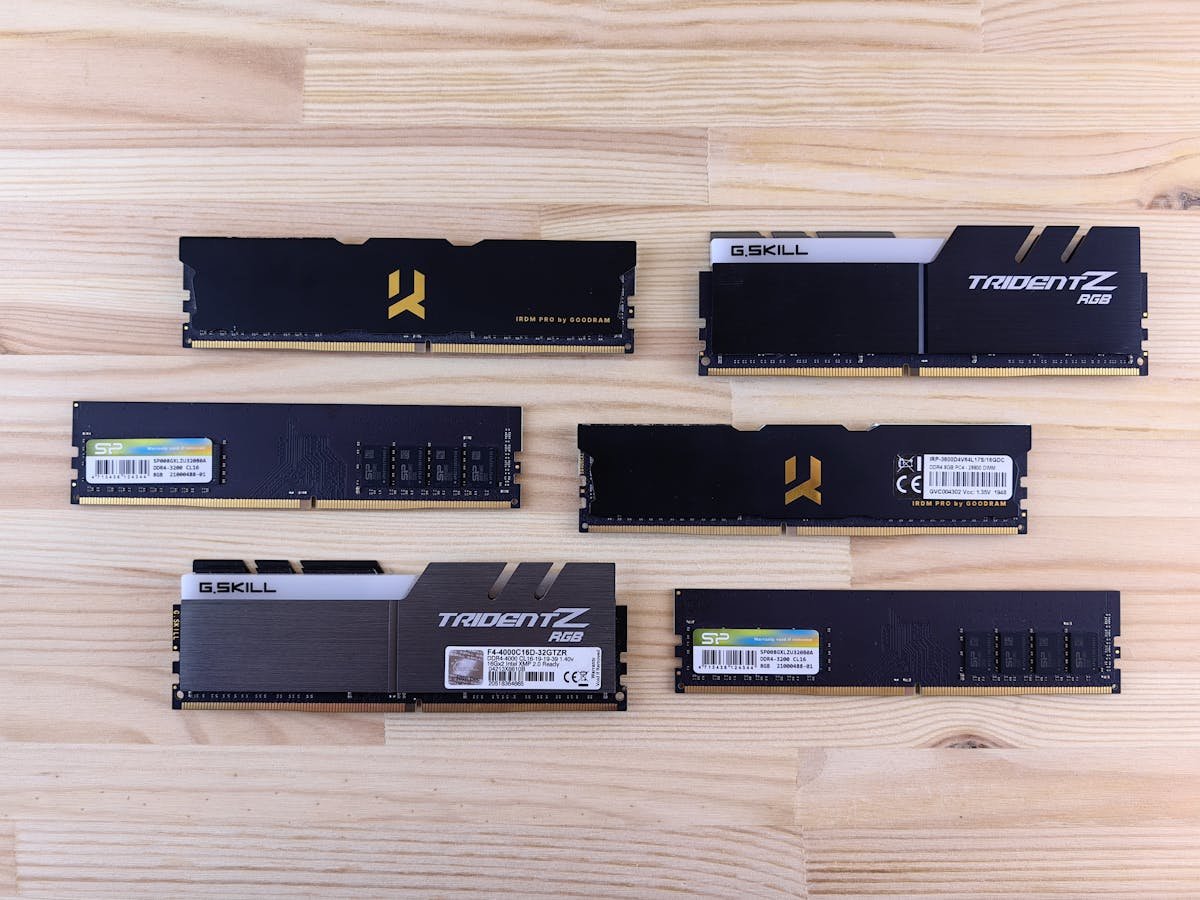
A standard form factor for RAM sticks used in desktop computers. 133.35mm long for full-size DIMM, with connections on both sides (hence “dual in-line”). Sits vertically in a slot. Not used in laptops—laptops use SO-DIMM instead.
Dual Channel
A memory architecture where the motherboard has two independent RAM slots, allowing parallel data transfer. Two identical RAM sticks running in dual channel (same speed, capacity, latency) provides approximately 10–15% performance gain over a single stick. Most modern laptops support dual channel but may have only one accessible slot (other slot is soldered, non-upgradeable). Matching speed and capacity is critical for stable dual-channel operation.
DWPD (Drive Writes Per Day)
A specification for SSDs, not RAM, but often confused with RAM warranties. Means the total amount of data that can be written to a drive daily over its warranty period. Not applicable to RAM (which doesn’t have write endurance limits like SSDs). Sometimes misread in specs.
ECC (Error-Correcting Code)
RAM with built-in error detection and correction. One extra bit per 8 bits of data detects and fixes single-bit errors automatically. Prevents data corruption from cosmic rays or electrical interference. Required for servers, workstations, and mission-critical systems. Adds ~10% latency penalty. Not available in consumer laptops—consumer RAM is non-ECC. Most consumer RAM cannot use ECC even if the motherboard supports it (compatibility is strict).
EXPO (Extended Profile for Overclocking)
AMD’s answer to Intel’s XMP. A profile system for DDR5 RAM that automatically sets timing, voltage, and frequency for overclocking on AMD Ryzen systems. Similar to XMP but not compatible (not interchangeable). Requires a Ryzen CPU and compatible motherboard. Consumer laptops rarely expose EXPO settings in BIOS.
Flex Mode (LPCAMM2)
A new memory feature in LPCAMM2 (low-power conjoined memory modules) that allows mixing different capacities (e.g., one 16GB + one 32GB) while maintaining dual-channel performance. Traditional dual-channel requires matching capacities. Only available in extremely new premium laptops (2024+). Most laptops still require matched pairs.
Frequency (MHz)
The clock speed of RAM, measured in megahertz (MHz). Higher frequency = more operations per second = faster data transfer. DDR4 typical: 2133–3600 MHz. DDR5 typical: 4800–6400 MHz. Frequency alone doesn’t determine performance—CAS latency and total timing profile matter equally. Matching frequency between two RAM sticks is essential for stable dual-channel operation.
JEDEC (Joint Electron Device Engineering Council)
The international standards body that defines RAM specifications. JEDEC standards ensure compatibility across manufacturers. All DDR4 and DDR5 modules have JEDEC standard operating profiles that guarantee basic functionality without overclocking. XMP and EXPO profiles are manufacturer-specific overclocking profiles that exceed JEDEC standards. JEDEC-only RAM is safe and stable but slower.
Latency (Memory Latency)
The time delay (measured in nanoseconds or clock cycles) between a memory request and data delivery. Lower latency = faster response. Example: DDR4-3200 CL16 has a latency of 10 nanoseconds. Latency matters more for responsiveness (everyday computing feel); bandwidth matters more for throughput (gaming, rendering). Users notice poor latency more than bandwidth.
LPCAMM2 (Low-Power Conjoined Memory Module 2)
A new form factor for laptop RAM designed to be soldered and upgradeable simultaneously (a hybrid approach). Thinner and lower-power than SO-DIMM. Designed to replace SO-DIMM in future ultra-thin laptops. Not yet widely available (2026 early adoption). When it arrives, LPCAMM2 will be the next-generation laptop memory standard, replacing SO-DIMM.
LPDDR5 (Low-Power DDR5)
Ultra-low-power variant of DDR5 designed for mobile devices (smartphones, tablets, some thin laptops). Uses 0.6V (half DDR5 voltage). Lower power consumption extends battery life. Slower than standard DDR5 (typically 6400 MT/s max vs 8533 MT/s for DDR5). Not upgradeable—soldered directly to the motherboard in phones and tablets. Some ultra-premium thin laptops may use LPDDR5, but it’s not user-upgradeable.
MLC (Multi-Level Cell)
A storage cell technology storing 2 bits per cell (used in SSDs and older NAND flash). Faster than TLC/QLC but with lower density. Now largely superseded. Not relevant to RAM—mostly an SSD specification.
MT/s (Megatransfers per Second)
A unit of data transfer speed used for DDR RAM. One MT/s = one million transfers per second. Example: DDR4-3200 performs 3200 MT/s. Different from MHz, which counts clock cycles. Due to double data rate, DDR4 at 1600 MHz clock = 3200 MT/s. The commercial designation always uses MT/s (DDR4-3200, not DDR4-1600).
MHz (Megahertz)
The internal clock frequency of RAM, measured in millions of cycles per second. DDR RAM speeds are marketed as the effective MT/s (double the actual MHz). Example: DDR4-3200 has internal frequency of 1600 MHz but effective speed of 3200 MT/s. Specification sheets sometimes show both MHz and MT/s—don’t confuse them.
Non-Registered Memory
Standard RAM where each address line is driven by a single register. Used in all consumer laptops and desktops. Contrasts with registered memory (used only in servers)—registered RAM adds a clock cycle delay. Consumer systems require non-registered RAM only.
Overclocking
Pushing RAM beyond manufacturer specifications by increasing voltage, frequency, or both. Common in gaming desktops using XMP profiles. Increases performance 5–10% but also increases power consumption, heat, and instability risk. Most consumer laptops don’t have BIOS controls for overclocking; many laptops use XMP automatically on applicable motherboards. Overclocked RAM voids warranties if it fails.
Quad Channel
A memory architecture with four independent RAM slots, each operating in parallel. Four sticks provide ~30% more bandwidth than dual channel (two sticks). Requires specific workstation or server motherboards. Not available in consumer laptops—dual channel is the maximum for consumer devices. High-end workstations and servers use quad channel.
Rank (Memory Rank)
The number of independent data arrays on a RAM module. Single Rank (1R) = one independent array. Dual Rank (2R) = two arrays (each 4GB on an 8GB module). Quad Rank (4R) = four arrays (rare in consumer RAM). Dual-rank modules are more common in 16GB+ capacities. Rank affects performance slightly—dual rank with proper configuration can improve bandwidth. However, matching rank between modules is less critical than matching speed and capacity.
Registered Memory
RAM with a register between the address lines and actual memory cells. Adds one clock cycle of latency but enables more stable operation with many modules. Used exclusively in servers and workstations. Not available or necessary in consumer laptops. Consumer laptops strictly use unbuffered/non-registered RAM.
Refresh Rate
The frequency at which DRAM must be electrically refreshed to maintain data (typically 64 milliseconds on modern RAM). Happens automatically—you don’t control it. All DRAM requires continuous refresh; SRAM does not. Not to be confused with monitor refresh rate (60Hz, 144Hz, etc.).
SDRAM (Synchronous Dynamic RAM)
Early RAM architecture predating DDR. Transferred data once per clock cycle. Now obsolete (replaced by DDR RAM since ~2002). Not relevant to modern laptops—all modern RAM is DDR (not SDRAM).
SODIMM (Small Outline DIMM)
The standard form factor for laptop RAM. 67.6mm long (half the size of a desktop DIMM). Sits vertically in a slot at 30-degree angle before being pressed flat. All modern laptop RAM is SO-DIMM. Cannot be mixed with desktop DIMM slots. Voltage and keying are the same between DDR4 and older DDR3 SO-DIMM physically, but DDR4 and DDR3 are electrically incompatible.
Solid State
A device with no moving parts (RAM, SSDs). Contrasts with mechanical (spinning hard drives). RAM is solid-state by definition (no moving parts). The term is often misused to describe only SSDs, but RAM is also solid-state.
SRAM (Static RAM)
A type of RAM that maintains data without constant electrical refresh. Faster than DRAM but more expensive and consumes more power per bit. Used only in CPU caches (L1, L2, L3 caches). Not used for system RAM in consumer devices. SRAM in CPU cache is what makes high-speed CPUs possible.
Speed (RAM Speed)
The data transfer rate of RAM, expressed in MT/s (megatransfers per second). Examples: DDR4-3200, DDR5-5600. Not the same as frequency (which is MHz). Speed determines bandwidth but not necessarily responsiveness (latency matters equally). Matching speed between two RAM modules is critical for dual-channel stability.
tRAS (Row Address Strobe)
The minimum time (in nanoseconds) required to maintain an open row in the RAM array. Higher values (more cycles) = slightly slower but more stable. Complex timing parameter that rarely needs adjustment. Timing profiles automatically set tRAS to safe values. Users rarely need to understand tRAS in detail.
tRC (Row Cycle Time)
The minimum number of clock cycles between opening one row and opening a different row. Higher = slower. Computed as tRP + tRAS. Not independently configured—set as part of timing profiles. Advanced users may adjust during overclocking, but default values are safe.
tRCD (Row to Column Address Delay)
The minimum number of clock cycles between opening a row and accessing a specific column within it. Lower is faster. Typical values: 14–16 cycles for DDR4, 28–34 for DDR5. Impacts latency and performance slightly. Matching tRCD between modules is less critical than matching CAS latency and speed.
tRP (Row Precharge Time)
The minimum time between precharging one row and opening a different row. Lower is faster. Typical values: 14–16 cycles DDR4, 28–34 DDR5. Works together with tRCD to determine row access performance. Both are part of the total timing profile.
Timings (RAM Timings)
A set of parameters that define RAM speed and stability: CAS Latency, tRCD, tRP, tRAS, etc. Written as a four-number string: CL-tRCD-tRP-tRAS. Example: 16-18-18-38. Always buy modules with matching timings for dual-channel stability. JEDEC profiles ensure compatibility; XMP profiles are manufacturer-specific overclocks with custom timings.
Unbuffered Memory
Standard RAM where addresses and commands go directly to memory cells without a register. Used in all consumer laptops and desktops. Slightly lower latency than registered RAM. All consumer RAM is unbuffered—only servers use buffered (registered) memory.
Voltage
The electrical potential supplied to RAM, measured in volts. DDR4 = 1.2V (standard), DDR5 = 1.1V. Lower voltage = less power consumption, less heat. Overclocked RAM may require higher voltage (1.35V+ for extreme overclocking). Always match voltage between modules—mixing 1.2V and 1.35V modules causes instability. Check motherboard specifications for supported voltages.
XMP (Extreme Memory Profile)
Intel’s system for storing overclocking profiles (custom timing, voltage, frequency) in RAM module firmware. Motherboard reads XMP data and automatically applies overclocked settings on boot. Provides 5–10% performance boost over JEDEC standard settings. Requires Intel CPU and compatible BIOS/motherboard. AMD Ryzen systems use EXPO instead (similar concept, different standard). Consumer laptops rarely expose XMP in BIOS—XMP is primarily for desktops and high-end workstations.
Quick Reference: Acronyms by Category
| Category | Terms |
|---|---|
| RAM Generations | DDR, DDR2, DDR3, DDR4, DDR5, LPDDR5 |
| Form Factors | DIMM, SO-DIMM, LPCAMM2 |
| Timing Parameters | CAS, tRCD, tRP, tRAS, tRC |
| Speed Units | MHz, MT/s, Bandwidth, Latency |
| Features | ECC, XMP, EXPO, Overclocking, Dual Channel, Rank |
| Architecture | DRAM, SRAM, Registered, Unbuffered, Keying |
Which Terms Matter Most for Laptop RAM?
For most users upgrading laptop RAM, understand these terms:
Essential (critical for compatibility): DDR4 vs DDR5, SO-DIMM, Voltage, Capacity (GB), Frequency (MT/s)
Important (affects performance): CAS Latency (CL), Dual Channel, Speed matching, Timings
Nice-to-know (minimal practical impact): Bandwidth, Rank, tRCD, tRP, tRAS
Rarely relevant for laptops: ECC, Registered, LPDDR5 (soldered only), Overclocking/XMP (laptops rarely expose BIOS controls)
Bottom line: Match speed, capacity, voltage, and form factor. Don’t obsess over latency differences (CL16 vs CL18) unless you’re a gamer or content creator—they make almost no difference for everyday users.
Frequently Asked Questions
What’s the difference between MHz and MT/s?
MHz is the internal clock frequency. MT/s is the effective speed (double the MHz due to double data rate). DDR4-3200 has 1600 MHz clock frequency but 3200 MT/s effective speed. Always use MT/s for comparisons (DDR4-3200, not DDR4-1600).
Does CAS Latency really matter for laptop performance?
Minimally. The difference between CL16 and CL20 is roughly 2–3 nanoseconds and affects performance by less than 1–2%. Matching speed (frequency) is far more important. Gamers and content creators notice slight improvements with low CAS latency, but casual users won’t perceive any difference.
Can I mix DDR4 and DDR5 RAM?
No. They are electrically incompatible and use different slot keying (different notch position). A DDR4 stick will not physically fit in a DDR5 slot and vice versa. The motherboard accepts one or the other, not both.
What does XMP do?
XMP (Intel) or EXPO (AMD) are overclocking profiles stored in RAM modules. When enabled in BIOS, the motherboard automatically applies custom timing, voltage, and frequency settings, boosting performance 5–10%. Consumer laptops rarely expose XMP—it’s primarily for desktops. Most laptops run at JEDEC standard speeds only.
Is ECC RAM compatible with consumer laptops?
No. Consumer laptops require non-ECC RAM. ECC RAM is specifically engineered for servers and workstations and won’t function reliably in consumer hardware. The motherboard must be designed to support ECC from the factory.
What does “dual channel” mean?
Dual channel means two RAM modules work together in parallel, providing approximately 10–15% more bandwidth than a single stick. Requires two identical (matching speed, capacity, timings) modules in correct slots. Most laptops support dual channel but may have one slot soldered (non-upgradeable), limiting your ability to use two modules.
Should I buy matched RAM kits?
Yes. Pre-matched kits (sold as pairs) guarantee compatibility. If buying separate sticks, match speed, capacity, voltage, and timings exactly. Mismatched RAM may work but is less stable and won’t perform as well.
Recommended Products
These are the products we recommend based on this guide. All links go to Amazon where you can check current prices and availability.
| Product | Why We Recommend It | Amazon |
|---|---|---|
| Corsair Vengeance DDR4 SO-DIMM 32GB (2×16GB) 3200MHz | Best overall DDR4 upgrade. Excellent build quality and proven compatibility with nearly all laptops. | View on Amazon |
| Kingston Fury Impact DDR4 SO-DIMM 32GB (2×16GB) 3200MHz | Reliable alternative with excellent latency (CL16). Great build quality and competitive pricing. | View on Amazon |
| Corsair Vengeance DDR5 SO-DIMM 32GB (2×16GB) 5600MHz | Best DDR5 upgrade for new gaming and productivity laptops. Premium build quality and performance. | View on Amazon |
| Kingston Fury Impact DDR5 SO-DIMM 32GB (2×16GB) 5600MHz | Excellent DDR5 alternative with tight latency and XMP support. Good value for performance. | View on Amazon |
| Crucial 32GB DDR4 SO-DIMM 3200MHz | Budget-friendly DDR4 option. Proven reliability from the manufacturer that owns Micron memory. | View on Amazon |
| Samsung 32GB DDR5 SO-DIMM 5600MHz | Samsung’s DDR5 option with tight latency and excellent build quality. Premium choice for new laptops. | View on Amazon |
Prices and availability may vary. As an Amazon Associate, we earn from qualifying purchases.
Related Guides
- RAM Compatibility Guide
- How Much RAM Do You Need?
- DDR4 vs DDR5 Laptop RAM
- How to Install Laptop RAM
- 8GB vs 16GB vs 32GB Laptop RAM
Try Our Free Compatibility Checker
Not sure what upgrades your laptop supports? Use our free Laptop Upgrade Compatibility Checker to find compatible RAM, SSD, and other upgrades for your specific model.
Recommended upgrades
As an Amazon Associate we earn from qualifying purchases. Prices & availability shown on Amazon.
For laptops and mini PCs that use DDR5 SO-DIMM
For laptops and mini PCs that use DDR4 SO-DIMM
How we verify this guide
We cross-reference compatibility figures against manufacturer specifications where available, official service manuals, and the standards that govern fit — memory type and speed (DDR4 / DDR5 / LPDDR5), maximum supported capacity and slot count, SSD form factor and interface (M.2 2280, NVMe PCIe vs SATA, keying), and charger wattage and connector (USB-C Power Delivery, GaN). We’re explicit about soldered or non-upgradeable parts, prioritise primary sources over retailer listings, and re-verify the data on a regular cycle. More on our method →