Affiliate disclosure: this page contains affiliate links — if you buy through them we may earn a commission at no extra cost to you. As an Amazon Associate we earn from qualifying purchases.
When you’re buying an SSD, you’ve probably noticed wildly different price points: a £150 Samsung 990 Pro, a £80 Crucial P5, a £50 Kingston A2000. Do these differences matter? Or is storage storage, and you should just buy the cheapest option? The answer: brand absolutely matters, but the specific features that matter depend on your use case.
What Separates Premium SSDs from Budget Options?
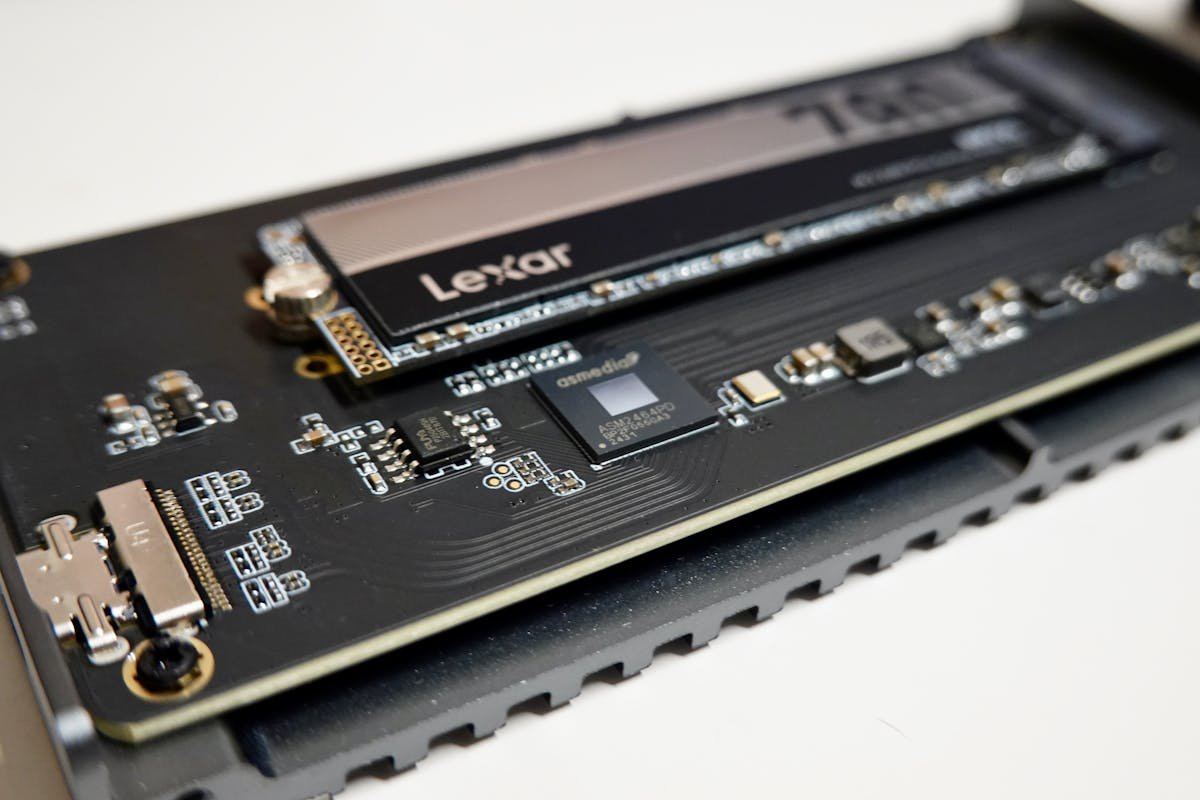
SSDs aren’t commodities like RAM (where speeds are standardized). Each brand makes different architectural choices in three key areas:
- Controller: The processor that manages data on the drive
- NAND type: The storage medium (TLC, QLC, etc.)
- DRAM cache: High-speed buffer memory
These components determine speed, reliability, and longevity. Let’s break down what you’re actually paying for.
The Big SSD Brands: Feature Comparison
Samsung 990 Pro (High-End NVMe)
Flagship: £200-350 for 1TB, PCIe 4.0, Up to 7,100 MB/s read
- Controller: Samsung’s own custom controller, highly optimized for speed and reliability
- NAND: Samsung 3-bit TLC (1 Tb class), their own production
- Cache: 1GB DRAM buffer on 1TB model
- Warranty: 5 years or 600 TBW (Tera Bytes Written)
- Best for: Creative professionals, high-speed data transfers, sustained workloads
- Real-world performance: Excellent sustained performance. Doesn’t throttle under heavy use. Maintains high speeds even after hundreds of GB of writes.
WD Black SN850X (High-End NVMe)
Price: £150-280 for 1TB, PCIe 4.0, Up to 7,100 MB/s read
- Controller: Western Digital proprietary controller, competitive with Samsung
- NAND: WD’s own TLC NAND
- Cache: 1GB DRAM on 1TB model
- Warranty: 5 years or 600 TBW
- Best for: Gaming, video editing, large file transfers
- Real-world performance: Similar to Samsung in testing. Popular for gaming rigs due to availability and brand recognition.
Crucial T500 (Mid-Range NVMe)
Price: £70-150 for 1TB, PCIe 4.0, Up to 5,400 MB/s read
- Controller: Micron Phison controller (co-developed)
- NAND: Micron 3D TLC NAND
- Cache: 1GB DRAM on 1TB model
- Warranty: 5 years or 600 TBW
- Best for: Everyday use, gaming, general productivity
- Real-world performance: Slightly slower peak speeds than Samsung/WD, but negligible in real-world use. Thermals are excellent (runs cool).
Kingston Fury Renegade (High-End NVMe)
Price: £100-200 for 1TB, PCIe 4.0, Up to 7,100 MB/s read
- Controller: Phison E18 controller (widely used by multiple brands)
- NAND: Micron or Samsung (depending on batch), 3-bit TLC
- Cache: 1GB DRAM on 1TB model
- Warranty: 5 years or 600 TBW
- Best for: Competitive gaming, value-conscious performance
- Real-world performance: Excellent; often equals Samsung in testing at a lower price point
Samsung 870 EVO (SATA SSD – Declining Category)
Price: £40-100 for 1TB, SATA, 560 MB/s read (max)
- Controller: Samsung MJX controller
- NAND: Samsung V-NAND TLC
- Cache: 1GB DRAM on 1TB model
- Warranty: 5 years or 2,400 TBW
- Best for: Upgrading old laptops with 2.5″ bays, mechanical hard drive replacements
- Real-world performance: Very reliable. Much faster than mechanical drives but slower than NVMe. Worth it only if your system doesn’t have an M.2 slot.
NAND Type: TLC vs QLC vs SLC
“Bits per cell” determines how much data each memory cell stores. This is critical to understanding price differences:
| NAND Type | Bits/Cell | Cost* | Durability (TBW) | Speed |
|---|---|---|---|---|
| SLC | 1 bit | Very high | Highest (3,000+ TBW) | Fastest |
| MLC | 2 bits | High | Very high (1,000-2,000 TBW) | Very fast |
| TLC | 3 bits | Medium (sweet spot) | Good (500-800 TBW typical) | Fast |
| QLC | 4 bits | Low (cheapest) | Adequate (200-400 TBW) | Slower after write cache |
What this means in practice:
TLC is the industry standard for consumer SSDs. It balances cost, performance, and durability. A TLC SSD rated for 600 TBW will last 15+ years for typical users (most people use 20-50 GB/year).
QLC is cheaper but less reliable. It has a smaller DRAM cache, which means after you fill the cache with large sequential writes, performance drops significantly. QLC is suitable for budget laptops and light users, but not ideal for content creators or power users.
Premium drives sometimes use MLC or enterprise-class NAND, which is overkill for consumer use and inflates the price.
DRAM Cache: Why Size Matters
SSDs use a small amount of fast DRAM as a buffer for incoming data. When you’re filling the drive quickly, it writes to this cache first (which is much faster), then slowly migrates data to the NAND cells.
- 1GB cache (standard): Handles most use cases. Sufficient for games, documents, photos.
- 2GB cache (premium drives): Better for sustained large file transfers. Slightly better for content creators doing 100+ GB daily transfers.
- No cache (some budget drives): Performance suffers significantly during sustained writes. Avoid if possible.
For typical laptop users, 1GB cache is fine. Content creators who routinely work with multi-gigabyte files benefit from larger caches.
Controller: The Brain of the Drive
The controller is an embedded processor that manages all data on the drive. Different brands use different strategies:
Custom Controllers (Samsung, WD, Intel): These companies design their own controllers optimized for their NAND. Result: tight integration, excellent reliability, but more expensive development.
Third-Party Controllers (Phison, Marvell): Companies like Kingston and Crucial often use Phison or Marvell controllers paired with various NAND. This approach is cheaper but still very reliable. Phison E18 controller is found in multiple high-performing drives at different price points.
For consumers, the brand and model matter more than knowing the specific controller. Just trust that premium brands invest in quality controllers, while budget options use solid but less advanced chips.
Endurance Rating (TBW): How Long Will It Last?
TBW (Tera Bytes Written) is an estimate of how much data can be written before the drive fails. Here’s what it means:
- 500 TBW: ~25 years for light users (10 GB/year writes), ~6 years for heavy users (80 GB/year writes)
- 600 TBW: Premium consumer drives; sufficient for virtually any personal use
- 800+ TBW: Workstation-grade; only needed for professional creators writing 100+ GB daily
Don’t obsess over TBW numbers.** Most consumer SSDs will outlive your device. Even a 500 TBW drive rated for 5 years will likely work flawlessly for 10+. Real-world failure is rare if you avoid physical damage or extreme heat.
Where TBW matters: If you’re a professional video editor, running a home server, or doing scientific computing, choose a drive rated for 800+ TBW. For everyone else, 500-600 TBW is more than sufficient.
Price Tiers: What You Get for Your Money
Budget Tier (£30-50 for 1TB SSD):
- Kingmax, SK Hynix, Addlink
- Often QLC NAND or budget TLC
- Slower controllers, minimal DRAM cache
- Better than a mechanical drive but noticeable lag during heavy use
- Good for: Replacing an old hard drive in a system you rarely use
- Avoid if: You use your computer daily; the performance difference will frustrate you
Mid-Range Tier (£50-100 for 1TB SSD):
- Crucial P3, Samsung 980, WD Blue SN570
- TLC NAND, balanced controllers
- 1GB DRAM cache typical
- Excellent real-world performance for everyday use
- Good for: Most laptop and desktop users, gaming, general productivity
- Best value: This tier offers the best price-to-performance ratio
High-End Tier (£100-200+ for 1TB SSD):
- Samsung 990 Pro, WD Black SN850X, Crucial P5
- Custom controllers, TLC NAND, 1-2GB DRAM cache
- Peak speeds up to 7,000+ MB/s
- Excellent sustained performance under load
- Good for: Content creators, professional video editors, network transfers
- ROI consideration: Only worth it if you regularly transfer 50+ GB files or do sustained heavy workloads
Gaming SSDs: Marketing vs Reality
“Gaming” SSDs (like WD Black SN850X, Samsung 970 EVO Pro) are marketed heavily to gamers. The truth: Gaming performance is virtually identical across brands in the mid-range and high-end tiers.
Why? Modern games load from SSDs so fast that the bottleneck is GPU, not storage. A Crucial P3 loads a game in 2 seconds, a Samsung 990 Pro loads it in 1.9 seconds. The difference is imperceptible.
Where gaming SSDs shine: Sustained performance when you have 100+ GB of games installed. This matters only if you’re constantly installing/uninstalling large titles. For casual gamers, a mid-range drive is fine.
Brand Reliability: Can You Trust the Data?
Statistically most reliable (according to failure rate studies):
- Intel (0.5-1% failure rate)
- Samsung (1-2% failure rate)
- WD/SanDisk (1-3% failure rate)
- Crucial (1.5-2.5% failure rate)
- Kingston (2-3% failure rate)
What this means: In a batch of 100 Samsung SSDs, 1-2 might fail in the first year. For Crucial, 1.5-2.5. The difference is marginal and doesn’t justify price premiums in real-world use.
Warranty as a proxy for reliability: Samsung, WD, and Crucial all offer 5-year warranties on consumer drives. If a brand is unsure of its product, it shortens the warranty. All major brands use 5 years for TLC drives, which suggests confidence.
Real-World Performance: Where It Matters and Where It Doesn’t
Does faster SSD matter for:
- System boot time: No. Boot goes from 30 seconds on HDD to 8 seconds on any SSD. Upgrading from one SSD to a faster one saves 0.5 seconds. You won’t notice.
- Gaming load times: Barely. Load time improves from 20 seconds to 18 seconds. Negligible.
- File copying (small files): No. Overhead masks the speed difference.
- File copying (large 50+ GB transfers): Yes. Premium drives outperform by 10-20%, saving minutes on massive operations.
- Video editing (4K raw footage): Yes. High-end drives handle sustained write operations better.
- Daily productivity (web, email, documents): No. Any SSD is fast enough that you can’t perceive the difference.
Verdict: For 90% of users, mid-range SSDs offer the best value. High-end drives are marketing to the 10% of power users who do sustained heavy workloads.
Laptop vs Desktop SSDs: Is There a Difference?
Short answer: No, not really. A Crucial P5 is a Crucial P5, whether it’s marketed as a laptop or desktop drive. Some drives are designed with laptop thermal constraints in mind (lower power consumption), but they work in both systems.
Exception: MacBooks use proprietary SSD modules that don’t work in other systems. If you own a Mac, you’re locked into Apple’s overpriced storage upgrades.
Should You Buy Used or Refurbished SSDs?
Used SSDs from reputable sellers: Generally safe if the drive hasn’t been filled more than 50% of its TBW rating. Check the S.M.A.R.T. data (health indicators) before buying.
Refurbished from manufacturer: Excellent value. Crucial and Samsung refurbished drives carry the same warranty as new and are indistinguishable after testing.
Avoid: Drives with no warranty, no health history, or from shady marketplaces.
Summary: Which SSD Should You Buy?
For most users (£50-80 budget): Crucial P3 or Samsung 980 — excellent value, proven reliability, real-world performance is indistinguishable from more expensive options.
For gamers (£80-120 budget): WD Blue SN570 or Kingston Fury Renegade — premium brands, excellent performance, popular choice in gaming communities.
For content creators (£120+ budget): Samsung 990 Pro or WD Black SN850X — sustained performance under heavy workloads, worth the premium if you work with large files daily.
For budget-conscious (£30-40): Only if you’re replacing a mechanical hard drive in a secondary system. For daily use, spend the extra £20 for better reliability and performance.
For legacy systems (2.5″ SATA): Samsung 870 EVO or Crucial MX500 — still excellent, more durable than modern NVMe due to lower write stress.
Final Thought: Future-Proofing
If you’re buying an SSD today, assume it will last 10+ years (even budget models). The real variable is your usage: a light user with a budget SSD will be fine; a heavy user needs premium. Choose based on your workload, not on marketing hype.
Need More Help?
See our SSD compatibility guide for your specific laptop or desktop, or check out our RAM compatibility guide for other upgrade decisions.
Recommended upgrades
As an Amazon Associate we earn from qualifying purchases. Prices & availability shown on Amazon.
M.2 2280 NVMe SSDs
How we verify this guide
We cross-reference compatibility figures against manufacturer specifications where available, official service manuals, and the standards that govern fit — memory type and speed (DDR4 / DDR5 / LPDDR5), maximum supported capacity and slot count, SSD form factor and interface (M.2 2280, NVMe PCIe vs SATA, keying), and charger wattage and connector (USB-C Power Delivery, GaN). We’re explicit about soldered or non-upgradeable parts, prioritise primary sources over retailer listings, and re-verify the data on a regular cycle. More on our method →
*Indicative UK street prices, shown for guidance only. These are not live Amazon prices and change frequently — check the current price on Amazon before buying.