Affiliate disclosure: this page contains affiliate links — if you buy through them we may earn a commission at no extra cost to you. As an Amazon Associate we earn from qualifying purchases.
You’ve probably seen the abbreviations TLC and QLC on SSD spec sheets and wondered what they mean. These letters describe how NAND flash storage works — specifically, how many bits of data each cell can store. The type of NAND directly impacts speed, endurance, cost, and whether the drive is right for your laptop or desktop.
Most consumers buy TLC drives — the sweet spot between performance and value. But QLC is cheaper and increasingly common in budget drives, while SLC and MLC are extinct or locked behind enterprise walls. In this guide, we’ll break down exactly what each NAND type is, why they differ, and which one you should actually buy.
How NAND Flash Storage Works — The Basics
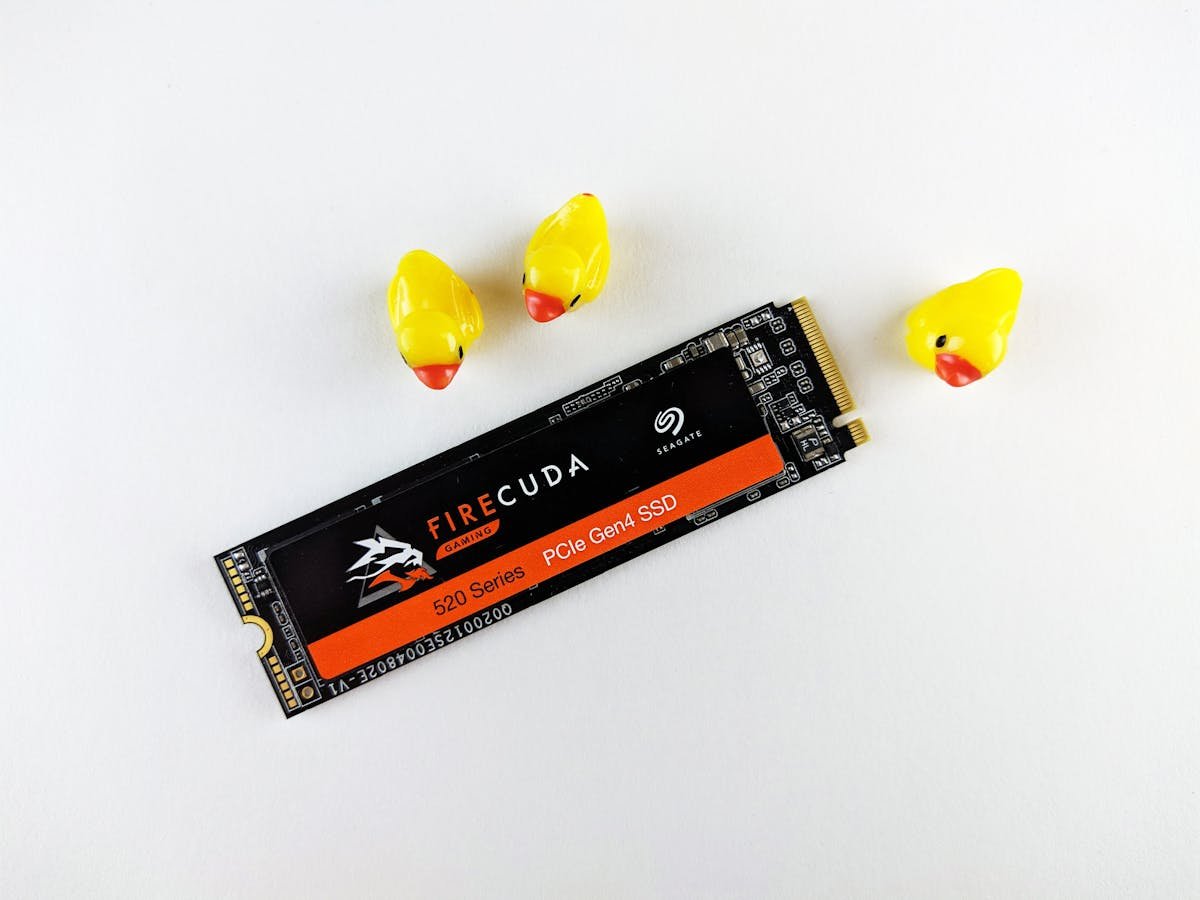
NAND flash memory stores data in tiny transistors called cells. Each cell holds an electric charge (or doesn’t), and that charge level encodes binary information.
Here’s the key insight: the more charge levels a cell can distinguish, the more bits it can store in a single cell.
- SLC (Single-Level Cell): 2 charge levels = 1 bit per cell
- MLC (Multi-Level Cell): 4 charge levels = 2 bits per cell
- TLC (Triple-Level Cell): 8 charge levels = 3 bits per cell
- QLC (Quad-Level Cell): 16 charge levels = 4 bits per cell
- PLC (Penta-Level Cell): 32 charge levels = 5 bits per cell (emerging, not yet consumer)
More bits per cell = cheaper storage (you can fit more data in the same physical space). But there’s a trade-off: distinguishing 16 charge levels is harder than distinguishing 2 levels, so speed and endurance suffer.
SLC vs MLC vs TLC vs QLC Comparison Table
| NAND Type | Bits per Cell | P/E Cycles | Speed | Cost per GB | Typical Use |
|---|---|---|---|---|---|
| SLC | 1 bit | ~100,000 | Fastest | Very expensive | Enterprise cache, data centres |
| MLC | 2 bits | ~10,000 | Fast | Expensive | High-end SSDs (mostly discontinued) |
| TLC | 3 bits | ~3,000 | Good | Moderate | Mainstream consumer SSDs — most popular choice |
| QLC | 4 bits | ~1,000 | Good (with SLC cache) | Cheap | Budget SSDs, large-capacity drives |
| PLC | 5 bits | ~500 | Moderate | Very cheap | Not yet available (next generation) |
Key takeaway: P/E (Program/Erase) cycles indicate how many times you can write to a cell before it wears out. More cycles = longer lifespan.
SLC — Single-Level Cell (Enterprise Only)
SLC is the oldest NAND technology and remains the fastest and most durable. It’s still used in some enterprise SSDs and data centre environments, but you will never buy an SLC SSD as a consumer.
Why? Economics. Storing 1 bit per cell means you need twice as many cells to store the same amount of data compared to MLC. A 1 TB SLC drive would be physically enormous and cost thousands of pounds.
SLC survives in niche enterprise and server applications where performance and longevity are worth the cost. For consumer storage, it’s extinct.
MLC — Multi-Level Cell (Mostly Discontinued)
MLC was the consumer standard before TLC arrived. It stores 2 bits per cell, offering a balance between speed and capacity.
MLC is effectively dead in the consumer market. It was phased out around 2015–2017 as TLC became cheaper and more reliable. You might find legacy MLC drives in old inventory or used markets, but buying new MLC is pointless — TLC is faster, cheaper, and more common.
Some high-end gaming drives and professional equipment still use MLC, but there’s no reason to choose MLC over TLC for a laptop or desktop build in 2026.
TLC — Triple-Level Cell (The Mainstream Sweet Spot)
TLC is the dominant NAND type for consumer SSDs in 2024–2026. It stores 3 bits per cell, balancing capacity, speed, and reliability.
TLC characteristics:
- Speed: Excellent sequential and random performance (500+ MB/s for SATA, 3,000+ MB/s for NVMe)
- Endurance: ~3,000 P/E cycles, which translates to 100+ TB of writes before the drive theoretically wears out (in practice, most TLC SSDs last 5–10 years of heavy use)
- Capacity: Available from 250 GB to 4 TB in consumer products
- Price: Affordable without being budget-tier
If you’re buying an SSD for a laptop, gaming PC, or content creation work in 2026, TLC is the sensible choice. It’s reliable, proven, and offers genuine value.
Examples of modern TLC SSDs:
- Samsung 990 Pro (PCIe 4.0 NVMe)
- WD Black SN850X (PCIe 4.0 NVMe)
- Kingston A3000 (PCIe 3.0 NVMe)
- Samsung 870 EVO (SATA SSD)
QLC — Quad-Level Cell (Budget and Large Capacity)
QLC is the newcomer, introduced by Intel around 2018 and now used by Samsung, SK Hynix, Kioxia, and others. It stores 4 bits per cell, making it the densest consumer NAND available.
QLC characteristics:
- Speed: Lower raw P/E cycles (~1,000), but modern QLC drives use SLC caching (see below) to deliver TLC-comparable burst speeds
- Endurance: ~1,000 P/E cycles, theoretically equivalent to 30–50 TB of writes — still enough for most consumers
- Capacity: Extremely high density allows 2 TB, 4 TB, and even 8 TB consumer drives at reasonable prices
- Price: Cheapest per GB of any consumer NAND type
QLC is ideal for:
- Budget-conscious buyers who want large storage (2–4 TB) on a tight budget
- Media libraries and archival storage (photos, videos, documents)
- Secondary or external drives
QLC is not ideal for:
- Heavy gaming installations (constant large file writes)
- Video editing or 3D rendering (sustained write performance matters)
- Mission-critical systems that must run continuously for years
PLC — Penta-Level Cell (Emerging Technology)
PLC is the next frontier in NAND density, storing 5 bits per cell. Samsung has announced PLC prototypes, but it’s not yet available in consumer products.
When PLC launches (likely 2026–2027), it will enable even cheaper, higher-capacity drives — but at the cost of lower endurance and potentially higher latency. For now, PLC is a lab curiosity.
SLC Cache Explained — Why QLC Can Feel Fast
QLC drives have a speed problem: with only 1,000 P/E cycles and 16 charge levels to distinguish, they’re inherently slower than TLC. But manufacturers work around this with SLC cache.
SLC cache is a clever trick: A portion of the QLC drive temporarily behaves like an SLC drive. When you write data, the drive treats a section of QLC cells as if each cell is an SLC cell (storing only 1 bit), allowing fast writes. Once the cache fills up, data is slowly compressed into QLC format in the background.
This is why a QLC drive can have excellent burst speed (fast when first writing a large file) but slower sustained speed (when the cache is full and you’re continuously writing).
Real-world example:
- Burst write: Copy 50 GB of video files to QLC drive = 500 MB/s (SLC cache is fast)
- After cache is full: Continuous 24-hour video encoding = 300 MB/s (writing to actual QLC layer is slower)
For most users (game installations, document editing, casual video editing), SLC cache provides enough speed that you’ll never notice the difference between QLC and TLC.
Real-World Performance — Does NAND Type Matter?
In practice, the differences between TLC and QLC are smaller than the spec sheet suggests:
| Workload | TLC | QLC (with SLC cache) | Noticeable Difference? |
|---|---|---|---|
| Gaming (load times) | ~2 seconds | ~2–3 seconds | No |
| OS boot time | ~10–15 seconds | ~10–15 seconds | No |
| Large file copy (burst) | ~500 MB/s | ~450–500 MB/s | No |
| Video rendering (sustained) | ~450 MB/s | ~250–350 MB/s | Yes, but still usable |
| Typical daily use | Excellent | Excellent | No |
Conclusion: For gaming, everyday computing, and web work, TLC and QLC feel identical. The gap only widens during sustained heavy writes (video encoding, large database operations).
3D NAND and V-NAND — What Are Layers?
All modern SSDs (TLC, QLC, and beyond) use 3D NAND architecture, meaning cells are stacked vertically in multiple layers, rather than arranged flat on a single plane.
More layers = more storage density without making the chip physically larger. For example:
- 2015: Samsung 850 EVO (2D NAND, single layer)
- 2018: Samsung 970 EVO (3D NAND, 5 layers)
- 2022: Samsung 990 Pro (3D NAND, 40+ layers)
- 2024: Latest SSDs (176+ layer 3D NAND)
V-NAND is Samsung’s marketing term for their specific 3D NAND implementation. Other manufacturers use their own names (SK Hynix calls theirs “PIM”, Kioxia calls theirs “BiCS”), but they’re all the same concept: stacked 3D cell architecture.
More layers generally means higher capacity and better performance, but the layer count alone doesn’t tell you if an SSD is good — controller quality, firmware, and thermal management matter just as much.
How to Identify NAND Type Before Buying
NAND type is almost never advertised on retail product pages. You have to dig into spec sheets or reviews:
Method 1: Check the Manufacturer’s Datasheet
Visit the SSD manufacturer’s website and download the full product datasheet (PDF). It will list the NAND type clearly under “Technical Specifications” or “Flash Memory”.
Method 2: Check Tech Review Sites
Sites like TechPowerUp, AnandTech, and Tom’s Hardware disassemble SSDs and identify the exact NAND chips used. Search “[SSD model] review NAND type” and you’ll usually find detailed breakdowns.
Method 3: Use Serial Number Tools
SSDz.com and ssd.borecraft.com are databases of SSD specifications. You can search by model number and they’ll show you the NAND type, controller, and endurance ratings.
Method 4: Contact Support
Email the manufacturer’s support team and ask directly. They’ll tell you without hesitation.
Which NAND Type Should You Buy?
For most people: Buy TLC. It’s the proven, reliable mainstream standard.
For budget builds: QLC is fine if you’re buying a 2–4 TB drive for storage or media. The SLC cache handles burst writes well, and you won’t feel the difference unless you’re encoding video for 8 hours straight.
For content creators: Stick with TLC NVMe drives. The sustained write speed matters for video editing, 3D rendering, and RAW photo processing.
For gaming: TLC NVMe with a PCIe 4.0 controller (500+ MB/s) is ideal. QLC works too, but you’re paying extra for capacity you don’t need.
For laptops: Prioritise the right form factor and size (2230, 2242, 2280) and connection type (NVMe M.2 or SATA) over NAND type. Most laptops come with TLC NAND anyway.
Recommended Products — Reliable SSDs by NAND Type
| Product | NAND Type | Capacity | Best For |
|---|---|---|---|
| Samsung 990 Pro | TLC | Up to 4 TB | Gaming, creative work, high performance |
| WD Black SN850X | TLC | Up to 4 TB | Gaming, PCIe 4.0 NVMe |
| Kingston A2000 / NV2 | QLC | Up to 2 TB | Budget builds, PCIe 3.0 |
| Samsung 870 EVO | TLC | Up to 4 TB | SATA SSD, reliable mainstream choice |
| Crucial T500 | TLC | Up to 2 TB | Mid-range NVMe, good value |
Prices and availability may vary. As an Amazon Associate, we earn from qualifying purchases.
FAQ — NAND Flash and SSD Storage
Is QLC bad for a laptop?
Not at all. Most modern laptops come with QLC NAND (to hit price points), and users experience no performance issues. QLC is perfectly fine for a laptop drive used for everyday work, gaming, and browsing. The SLC cache ensures snappy performance for typical workloads.
Will TLC last long enough for my needs?
Absolutely. A TLC SSD with 3,000 P/E cycles translates to around 100+ TB of total writes before theoretical wear-out. In real-world use, most drives last 5–10 years before failing. Unless you’re encoding video or running database servers 24/7, endurance is not a practical concern.
Does NAND type matter more than the controller?
Both matter, but the controller often matters more. A great controller with QLC NAND (like Samsung 870) will outperform a cheap controller with TLC NAND. Check reviews before buying — the reviewer will test real-world speed and reliability.
What is SLC cache and why does it matter?
SLC cache is a portion of QLC storage that temporarily acts like SLC to enable fast writes. Once full, performance drops because you’re writing to the slower QLC layer. For burst writes (copying large files), SLC cache is excellent. For continuous writes over hours, it matters less. Most consumers won’t notice the difference.
Is MLC still available or used in new SSDs?
MLC is virtually extinct in the consumer SSD market. A few enterprise and professional SSDs still use it, but there’s no reason to buy MLC over TLC. If you find an MLC SSD for sale, it’s likely old inventory — avoid it.
What is the endurance rating (TBW) and should I care?
TBW (TeraBytes Written) is the manufacturer’s guarantee of how much data you can write before the drive might fail. A typical 1 TB SSD might have a 300 TBW rating. This sounds low, but it’s equivalent to writing the entire drive 300 times. For most users (5–10 GB of writes per day), it’ll take 60–100 years to reach that limit. Don’t worry about TBW unless you’re running a data centre.
Related Guides
- SSD Endurance and TBW Explained — How Long Will Your Drive Last?
- NVMe vs SATA SSD — Speed, Compatibility & Performance
- Laptop SSD Compatibility Guide — NVMe, SATA, M.2 Sizes Explained
- 2230 vs 2242 vs 2280 SSD — Form Factor Guide for Laptops
Recommended upgrades
As an Amazon Associate we earn from qualifying purchases. Prices & availability shown on Amazon.
M.2 2280 NVMe SSDs
How we verify this guide
We cross-reference compatibility figures against manufacturer specifications where available, official service manuals, and the standards that govern fit — memory type and speed (DDR4 / DDR5 / LPDDR5), maximum supported capacity and slot count, SSD form factor and interface (M.2 2280, NVMe PCIe vs SATA, keying), and charger wattage and connector (USB-C Power Delivery, GaN). We’re explicit about soldered or non-upgradeable parts, prioritise primary sources over retailer listings, and re-verify the data on a regular cycle. More on our method →