
Affiliate disclosure: this page contains affiliate links — if you buy through them we may earn a commission at no extra cost to you. As an Amazon Associate we earn from qualifying purchases.
DIMM and SODIMM are two different physical form factors for RAM, and they are completely incompatible with each other. Understanding the differences is crucial to avoid buying the wrong RAM for your system.
Quick Comparison
| Spec | DIMM | SODIMM |
|---|---|---|
| Length | ~273 mm (desktop) | ~67 mm (laptop-sized) |
| Common Name | Desktop RAM | Laptop/Mini PC RAM |
| DDR4 Pins | 288 pins | 260 pins |
| DDR5 Pins | 288 pins | 262 pins |
| Height | ~30–35 mm (varies with heatsink) | ~30 mm |
| Typical Capacity Range | 2GB–128GB per stick | 1GB–32GB per stick |
| Speed Range | 2133–8000+ MHz | 1333–4800 MHz |
| Primary Use | Desktop PCs, Servers, Workstations | Laptops, Mini PCs, Tablets |
| Price per GB | £2–5 | £3–8 (premium due to demand) |
| Backward Compatible? | No | No |
What Is DIMM?
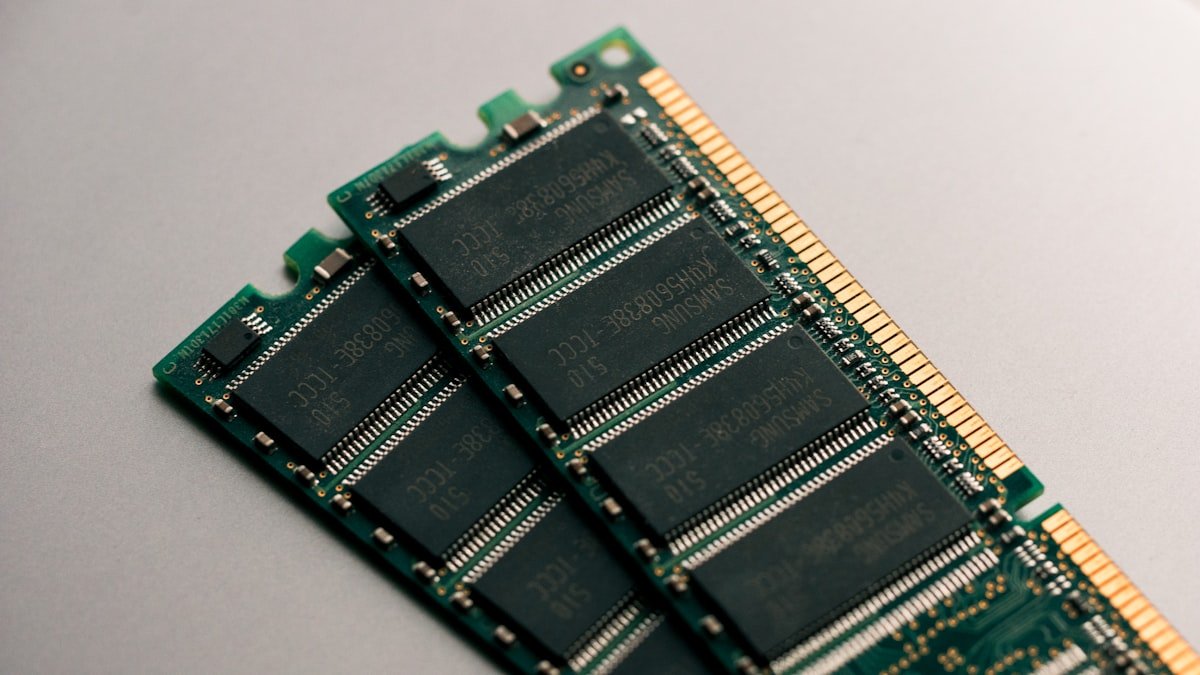
DIMM stands for Dual In-line Memory Module. These are full-sized RAM sticks used in desktop computers, servers, and workstations. The “dual in-line” refers to the gold connector pins on the bottom of the module — there are contact pins on both sides.
DIMM Physical Characteristics
Length: Approximately 273 mm (just over 10 inches). This is the standard desktop form factor that’s been around since the 1980s (with different connector types).
Pin count:
- DDR4 DIMM: 288 pins (with key notch offset slightly left)
- DDR5 DIMM: 288 pins (with key notch more centered and deeper than DDR4)
Height: 30–35 mm depending on heatsink design. Some gaming or enthusiast modules have large aluminum heatsinks that add height, requiring tall DIMM slots in your PC case.
Slot keying: The key notch prevents DDR4 from physically fitting into DDR5 slots, and vice versa. This protects your hardware from incompatible RAM.
DIMM Speeds and Capacities
Modern DIMM speeds:
- DDR4: 2133 MHz to 4800 MHz (JEDEC) and up to 5200+ MHz (overclocker editions)
- DDR5: 4800 MHz (JEDEC) and up to 8000+ MHz (high-end gaming and overclocked modules)
Typical capacities: 4GB, 8GB, 16GB, 32GB, and 64GB sticks are standard. Enterprise DDR4 goes up to 128GB per stick.
Why desktop RAM can be so fast: Desktop motherboards don’t have as many power and thermal constraints as laptops, allowing manufacturers to push DIMM speeds higher.
What Is SODIMM?
SODIMM stands for Small Outline Dual In-line Memory Module. These are smaller, more compact RAM sticks designed for space-constrained devices like laptops and mini PCs.
SODIMM Physical Characteristics
Length: Approximately 67 mm (about 2.6 inches). This compact size allows laptops to have RAM slots while keeping the overall chassis thin.
Pin count:
- DDR4 SODIMM: 260 pins (key notch offset toward the middle-left)
- DDR5 SODIMM: 262 pins (key notch more prominent, slightly different spacing)
Height: ~30 mm. SODIMM sticks are nearly as tall as DIMM sticks but significantly shorter in length.
Slot keying: DDR4 SODIMM and DDR5 SODIMM have different notches, preventing accidental installation of incompatible RAM.
SODIMM Speeds and Capacities
Typical SODIMM speeds:
- DDR4 SODIMM: 2133 MHz to 3200 MHz (mainstream), with some gaming laptops reaching 3600 MHz
- DDR5 SODIMM: 4800 MHz to 5600 MHz (standard), with some premium models reaching 6400 MHz or higher
Typical capacities: 4GB, 8GB, 16GB, and 32GB sticks. Some gaming laptops and mini PCs come with up to 64GB configurations (usually two 32GB sticks).
Why SODIMM speeds are lower: Laptops have limited cooling, smaller circuit board traces, and tighter power budgets. High frequencies generate more heat and power draw, which laptop cooling systems struggle to manage.
Physical Comparison: Side by Side
If you placed a DIMM and SODIMM side by side:
- DIMM: Long (273 mm), relatively narrow, full-sized
- SODIMM: Compact (67 mm), dense in features, half the length of DIMM
The SODIMM slot on a laptop motherboard is visibly smaller than a DIMM slot on a desktop motherboard. Trying to force a DIMM into a SODIMM slot (or vice versa) will not work — the mechanical keying prevents insertion.
Pin Count Differences Explained
Why Different Pin Counts?
SODIMM uses fewer pins because it’s a more compact design. The 260-pin SODIMM DDR4 versus 288-pin DIMM DDR4 reflects the same electrical signals but routed differently to save space.
Functionally: Both carry the same data bus width (64 bits of data per channel) but achieve it with different pin layouts.
DDR4 to DDR5 Migration
DDR5 added an extra 2 pins on SODIMM (260 → 262) to support new features like on-module voltage regulation. DIMM stayed at 288 pins in both DDR4 and DDR5 (the extra pins are for additional power rails, not data).
Key Difference: DIMM vs SODIMM Is Not Backward Compatible
You cannot use DIMM RAM in a SODIMM slot, and vice versa. This is by design — the physical keying prevents mismatched RAM from being installed.
What Happens If You Try?
- Physically: The RAM stick will not align with the slot’s key. You cannot push it in without excessive force (which you should never apply).
- If you somehow forced it: You would break the RAM, the slot, or both. The different pin arrangements mean electrical signals wouldn’t match up.
The Correct Approach
Before buying RAM, know your system type:
- Desktop PC: Buy DIMM RAM
- Laptop or mini PC: Buy SODIMM RAM
Check your motherboard manual or your system’s documentation. Never assume; one wrong purchase wastes money and is often non-refundable.
Special Case: Mini PCs and NUCs
Some desktop-replacement systems (Intel NUC, small form-factor PCs, media centers) use SODIMM slots instead of DIMM slots to save space. These are technically “desktops” but use SODIMM RAM.
How to identify: Check your motherboard manual or look at your RAM slots physically. If you can see the actual slot through the case, it’s very small and compact — that’s a SODIMM slot. DIMM slots are much longer and more obvious.
Speed and Capacity Limits
Why DIMM Supports Higher Speeds
Thermal management: Desktop cases have larger heatsinks and active cooling. DIMM sticks can run at higher speeds with better thermal stability.
Power delivery: Desktop motherboards have more robust power delivery systems that can supply stable voltage at high frequencies.
Trace quality: Larger PCBs in DIMM modules allow for better signal integrity at high speeds.
SODIMM Practical Limits
Laptops running DDR5-6400 SODIMM are at the upper practical limit for most systems. Beyond this, heat becomes unmanageable in a thin laptop chassis. This is why you don’t see many DDR5-8000 SODIMM modules — there’s simply no demand (and they wouldn’t work well thermally).
Cost Differences
SODIMM RAM typically costs 20–60% more per GB than DIMM RAM, despite being less advanced:
Why SODIMM is expensive:
- Smaller manufacturing scale (fewer laptops than desktops use upgradeable RAM)
- Higher demand relative to supply (many laptop owners want to upgrade)
- Lower yields in manufacturing (compact designs are harder to produce at scale)
A 16GB DDR4 DIMM costs ~£40–80, while a 16GB DDR4 SODIMM costs ~£60–120. Upgrade your laptop RAM and you’ll feel this premium.
Upgrading Your System
Upgrading a Desktop (DIMM)
Easy and inexpensive. DIMM RAM is abundant, affordable, and available in many speeds and capacities. Most desktop motherboards have 2–4 DIMM slots.
Upgrading a Laptop (SODIMM)
Possible but expensive. First, check if your laptop has a serviceable RAM slot (many newer laptops solder RAM directly to the motherboard, making upgrades impossible).
If your laptop is upgradeable: Buy matching SODIMM RAM for your specific laptop model. Consult your laptop’s manual or the manufacturer’s website for the correct specifications.
Cannot Upgrade? Alternatives
- External RAM (USB dongle): Some devices support external USB RAM, but it’s slower and not practical for daily use.
- Storage optimization: Use virtual RAM (pagefile) or cloud storage to compensate for insufficient RAM.
- Replace the laptop: If soldered RAM is the limiting factor and you need more memory, you may need to buy a new laptop with upgradeable RAM.
Common Mistakes to Avoid
Mistake 1: Buying DIMM for a Laptop
You’ll realize too late that it won’t fit. DIMM is much longer than a SODIMM slot. The notches don’t align. You can’t return it because it’s visibly unsuitable.
Prevention: Always check whether your device uses DIMM or SODIMM before purchasing. Read the product listing carefully — it will specify “Desktop DIMM” or “Laptop SODIMM”.
Mistake 2: Mixing DDR4 and DDR5 SODIMM
DDR4 SODIMM and DDR5 SODIMM have different notches. You cannot accidentally install one in a DDR5 slot (or vice versa). However, many people buy the wrong generation by mistake.
Prevention: Know your laptop’s RAM type. Check your laptop manual or use CPU-Z to verify DDR4 vs DDR5 before buying.
Mistake 3: Assuming All SODIMM Fit All Laptops
Not all SODIMM are equal. Voltage, speed, and latency vary. A DDR4-3200 SODIMM from one brand may not work in a laptop that expects DDR4-2666.
Prevention: Check your laptop’s QVL (Qualified Vendor List) or manual for compatible RAM models. If available, buy the exact model specified by the manufacturer.
Quick Identification Guide
Visual identification:
- DIMM: Long stick (~27 cm / 10.6 inches), fits vertically into desktop motherboards
- SODIMM: Short stick (~6.7 cm / 2.6 inches), fits vertically into laptop motherboards or small form-factor desktops
Slot identification:
- DIMM slot: Long slot on desktop motherboards, clearly visible, accommodates tall sticks
- SODIMM slot: Compact slot on laptop motherboards, often hidden under keyboard or behind a panel
Future: Will SODIMM Become DIMM-Like?
Unlikely in the near term. The trend in laptops is toward non-upgradeable soldered RAM (to save space and weight). Fewer laptops have serviceable RAM slots with each generation.
For desktops: DIMM will remain the standard. As long as desktop towers exist, DIMM RAM will be the industry norm.
Related Guides
Prices and availability may vary. As an Amazon Associate, we earn from qualifying purchases.
Recommended RAM Modules
Verified compatible products with free UK delivery via Amazon Prime.
Corsair Vengeance LPX 32GB (2x16GB) DDR4 DIMM
Full-size desktop DIMM — most popular DDR4 kit
Check Price on AmazonCorsair Vengeance 32GB (2x16GB) DDR5 SO-DIMM 4800MHz
Laptop SO-DIMM DDR5 for upgradeable notebooks
Check Price on AmazonKingston FURY Impact 32GB (2x16GB) DDR4 SO-DIMM 3200MHz
High-performance laptop SO-DIMM
Check Price on AmazonAs an Amazon Associate, Computer Compatibility earns from qualifying purchases at no extra cost to you.
Recommended upgrades
As an Amazon Associate we earn from qualifying purchases. Prices & availability shown on Amazon.
For laptops and mini PCs that use DDR5 SO-DIMM
For laptops and mini PCs that use DDR4 SO-DIMM
How we verify this guide
We cross-reference compatibility figures against manufacturer specifications where available, official service manuals, and the standards that govern fit — memory type and speed (DDR4 / DDR5 / LPDDR5), maximum supported capacity and slot count, SSD form factor and interface (M.2 2280, NVMe PCIe vs SATA, keying), and charger wattage and connector (USB-C Power Delivery, GaN). We’re explicit about soldered or non-upgradeable parts, prioritise primary sources over retailer listings, and re-verify the data on a regular cycle. More on our method →