
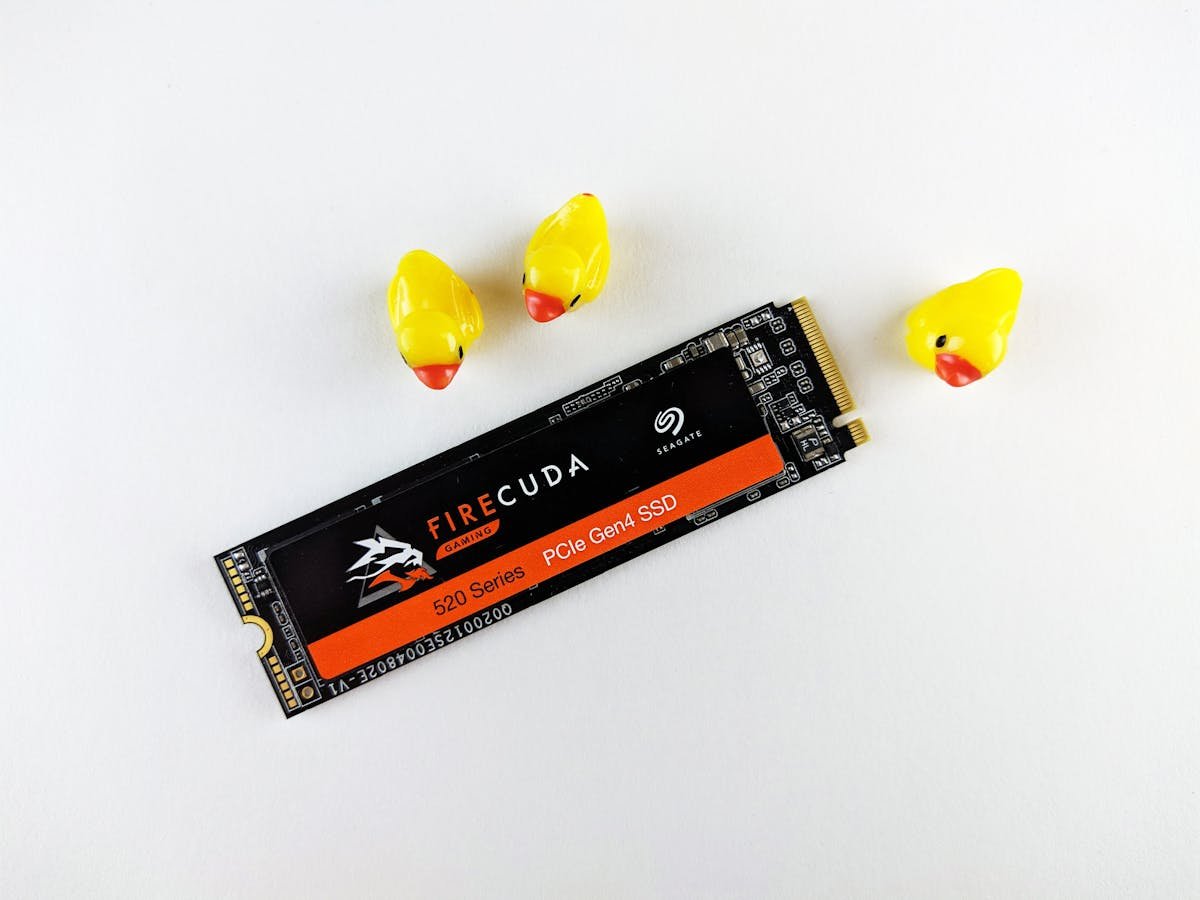
NVMe SSDs have become the gold standard for laptop and desktop storage in 2026, offering read speeds up to 14,000 MB/s — roughly 100 times faster than a traditional hard drive. With prices dropping below £50 for 1TB drives, there’s never been a better time to upgrade. This guide compares the best NVMe SSDs available in the UK across every budget and use case.
Table of Contents
- Best NVMe SSDs 2026: Quick Comparison
- PCIe Gen 3 vs Gen 4 vs Gen 5: Which Do You Need?
- M.2 SSD Sizes: 2230 vs 2242 vs 2280
- Capacity: How Much SSD Storage Do You Need?
- Best NVMe SSD by Use Case
- How to Install an NVMe SSD
- Recommended Products
- Frequently Asked Questions
Best NVMe SSDs 2026: Quick Comparison
| SSD | Gen | Read Speed | 1TB Price | Best For |
|---|---|---|---|---|
| Samsung 990 EVO Plus | Gen 4 | 5,000 MB/s | ~£65 | Best overall |
| WD Blue SN580 | Gen 4 | 4,150 MB/s | ~£48 | Best value |
| Samsung 990 Pro | Gen 4 | 7,450 MB/s | ~£85 | Best Gen 4 performance |
| Crucial T500 | Gen 4 | 7,300 MB/s | ~£75 | Best for gaming |
| Kingston NV2 | Gen 4 | 3,500 MB/s | ~£40 | Budget pick |
| Crucial P310 | Gen 4 | 7,100 MB/s | ~£55 | Best mid-range |
| WD Black SN850X | Gen 4 | 7,300 MB/s | ~£80 | Best for PS5 |
PCIe Gen 3 vs Gen 4 vs Gen 5: Which Do You Need?
| Generation | Max Speed | Typical Price/TB | Who Needs It |
|---|---|---|---|
| PCIe Gen 3 | 3,500 MB/s | £35-50 | Older systems, budget upgrades |
| PCIe Gen 4 | 7,000 MB/s | £45-85 | Most users — sweet spot in 2026 |
| PCIe Gen 5 | 14,000 MB/s | £100-200 | Enthusiasts, professionals only |
For the vast majority of users in 2026, a PCIe Gen 4 NVMe SSD is the best choice. Gen 4 drives offer excellent performance at competitive prices. Gen 5 drives are available but the premium is hard to justify for most use cases — the speed difference is only noticeable in very specific professional workloads like large video file editing or massive data transfers.
Gen 4 drives are backwards compatible with Gen 3 slots (they’ll just run at Gen 3 speeds), and Gen 5 drives work in Gen 4 slots. You can always install a faster drive than your slot supports without any issues.
M.2 SSD Sizes: 2230 vs 2242 vs 2280
NVMe SSDs come in three common M.2 sizes. The numbers refer to width and length in millimetres. M.2 2280 (22mm wide, 80mm long) is the most common standard size used in most laptops and desktops. M.2 2242 (42mm long) is used in some compact laptops and mini PCs. M.2 2230 (30mm long) is used in ultraportables, Microsoft Surface devices, Steam Deck, and some Dell XPS models.
Always check which M.2 size your device supports before buying. Installing a 2280 drive in a 2230 slot is physically impossible — the drive simply won’t fit. Some devices support multiple sizes with adjustable screw positions.
Capacity: How Much SSD Storage Do You Need?
In 2026, we recommend 512 GB as the minimum and 1 TB as the sweet spot for most users. Game libraries, photos, and applications keep growing, and the price difference between 512 GB and 1 TB has narrowed significantly. For content creators and gamers with large libraries, 2 TB provides comfortable headroom without breaking the bank.
Always leave 10-20% of your SSD free for optimal performance. SSDs slow down significantly when nearly full because the controller has fewer empty blocks to work with.
Best NVMe SSD by Use Case
| Use Case | Our Pick | Why |
|---|---|---|
| Everyday laptop upgrade | Samsung 990 EVO Plus 1TB | Excellent all-round performance, great reliability |
| Budget upgrade | Kingston NV2 1TB | Under £40, still dramatically faster than HDD |
| Gaming PC / PS5 | WD Black SN850X 2TB | Fast loads, heatsink option, PS5 compatible |
| Video editing | Samsung 990 Pro 2TB | Sustained write speeds for large files |
| Steam Deck / Surface | WD SN740 2230 1TB | M.2 2230 form factor, excellent value |
| Maximum capacity | Crucial T500 4TB | 4 TB NVMe at competitive pricing |
How to Install an NVMe SSD
Installing an NVMe SSD is one of the simplest computer upgrades. For laptops: turn off and unplug, remove the bottom panel screws, locate the M.2 slot, insert the SSD at a 30-degree angle into the slot, press it flat and secure with the mounting screw. For desktops: locate the M.2 slot on your motherboard, remove any heatsink if present, insert and secure.
After installation, you’ll need to either clone your existing drive or install a fresh operating system. For a fresh install, create a Windows installation USB on another computer and boot from it. For cloning, use free tools like Macrium Reflect or the manufacturer’s cloning software.
Recommended Products
Our top overall pick. Up to 5,000 MB/s reads with excellent endurance and Samsung’s reliability reputation.
From £65 · Check Price on Amazon UK →
Best value Gen 4 drive. Consistent 4,150 MB/s reads at under £50. Great for everyday computing.
From £48 · Check Price on Amazon UK →
Top-tier Gen 4 performance with 7,450 MB/s reads. Ideal for content creators and professionals.
From £130 · Check Price on Amazon UK →
Best budget NVMe SSD. Under £40 for 1TB with 3,500 MB/s reads. Perfect for HDD-to-SSD upgrades.
From £38 · Check Price on Amazon UK →
Frequently Asked Questions
Is NVMe faster than SATA SSD?
Yes, significantly. SATA SSDs max out at ~550 MB/s, while NVMe Gen 4 drives reach 7,000+ MB/s. For booting and loading programs, the difference is noticeable. For large file transfers and professional workloads, NVMe is dramatically faster.
Will a Gen 4 NVMe SSD work in my Gen 3 slot?
Yes, NVMe drives are backwards compatible. A Gen 4 SSD will work in a Gen 3 M.2 slot — it will just run at Gen 3 speeds (up to 3,500 MB/s). This is still very fast and a worthwhile upgrade.
How long do NVMe SSDs last?
Modern NVMe SSDs are rated for hundreds of terabytes of writes (TBW). A 1 TB drive rated at 600 TBW could handle writing 100 GB daily for over 16 years. In practice, most NVMe SSDs will outlast the computer they’re installed in.
Do I need a heatsink for my NVMe SSD?
For laptops, no — there isn’t space. For desktops, a heatsink is recommended for Gen 4 and Gen 5 drives under sustained workloads (video editing, large file transfers). For everyday use, even desktop Gen 4 drives work fine without heatsinks.
Can I use an NVMe SSD in a PS5?
Yes, the PS5 has an M.2 2230 expansion slot that supports Gen 4 NVMe drives. Popular choices include the WD Black SN850X and Samsung 990 Pro, both with optional heatsinks designed for the PS5.
Is it worth upgrading from Gen 3 to Gen 4 NVMe?
For most users, no. The real-world difference in boot times and program loading is minimal. However, if you work with large files regularly (video editing, data processing), the faster sequential speeds of Gen 4 are noticeable. For a new purchase, Gen 4 makes sense since prices are now comparable.
Final Thoughts
NVMe SSD prices in 2026 make this the best time ever to upgrade your storage. For most users, the Samsung 990 EVO Plus offers the ideal balance of performance, reliability, and price. Budget shoppers should consider the Kingston NV2 or WD Blue SN580, while professionals and gamers will benefit from the Samsung 990 Pro or Crucial T500.
Check Your Laptop’s Compatibility
Use our free tool to find compatible RAM and SSD upgrades for your specific laptop model.
Launch Compatibility Checker →Shop NVMe SSDs at PCHub.UK
Prices updated automatically from PCHub.UK — click to view full specs and buy

Prices from PCHub.UK via ComputersDeal. As an affiliate, we may earn from qualifying purchases. Prices updated 2026-04-10 13:15:58.