
Affiliate disclosure: this page contains affiliate links — if you buy through them we may earn a commission at no extra cost to you. As an Amazon Associate we earn from qualifying purchases.
When upgrading RAM, you often face a trade-off: more RAM at a lower speed, or faster RAM with less capacity. The answer depends on your workload — and it is not always intuitive. This guide uses real-world data to help you make the right choice.
Capacity Almost Always Wins
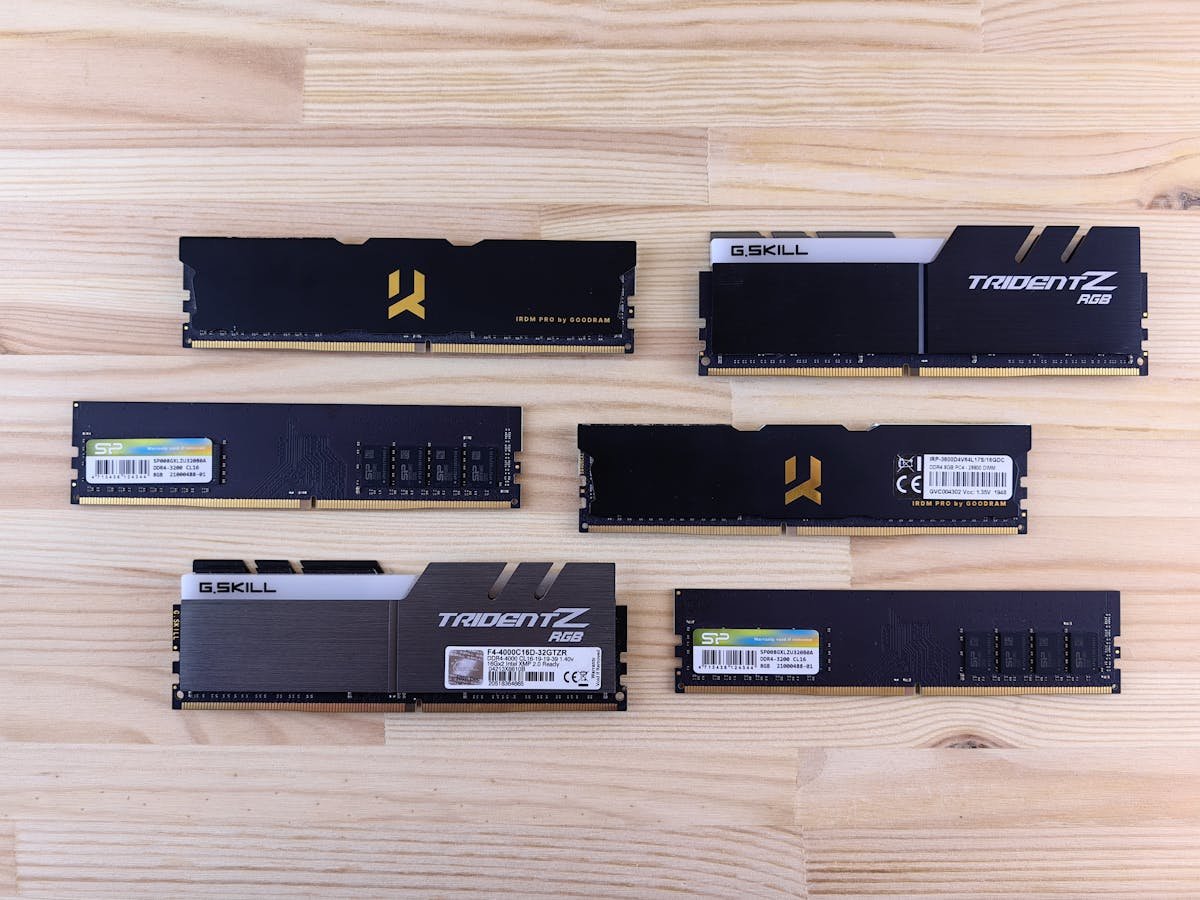
In the vast majority of use cases, having enough RAM is far more important than having fast RAM. When your system runs out of RAM, it pages data to the SSD (swap/page file), which is 10-100x slower than even the slowest DDR4. This causes dramatic slowdowns, stuttering, and poor responsiveness.
- A system with 32GB DDR4-2666 will outperform 16GB DDR5-6400 if the workload needs 20GB+
- Running out of RAM causes disk paging — performance drops by 10-100x
- 16GB at 3200MHz beats 8GB at 6000MHz in every scenario where memory usage exceeds 8GB
- Always prioritise having enough capacity for your workload, then optimise speed
When Speed Matters
RAM speed has measurable impact in specific scenarios:
| Scenario | Speed Impact | Capacity Impact | Priority |
|---|---|---|---|
| Gaming (1080p CPU-bound) | 3-8% FPS gain | No effect if under 16GB | Speed (if 16GB+ already) |
| Gaming (1440p/4K GPU-bound) | 0-2% FPS gain | No effect if under 16GB | Neither — GPU limited |
| Video editing | 2-5% render improvement | Critical if timeline > RAM | Capacity first |
| 3D rendering | 3-8% improvement | Critical for large scenes | Capacity first |
| Photo editing (Lightroom) | Minimal | Large catalogs need 32GB+ | Capacity first |
| Software compilation | 5-10% improvement | Needs to fit build in RAM | Both matter |
| Web browsing | Negligible | More tabs = more RAM needed | Capacity first |
| Virtual machines | Minimal per-VM gain | Each VM needs its allocation | Capacity wins |
Sweet Spot Configurations for 2026
Based on the analysis above, here are the optimal configurations:
- Budget build: 32GB DDR4-3200 (~£55) — capacity and adequate speed
- Mid-range: 32GB DDR5-5600 (~£75) — excellent balance of capacity and speed
- Gaming focused: 32GB DDR5-6000 CL30 (~£95) — optimised for AMD Ryzen systems
- Workstation: 64GB DDR5-5600 (~£140) — capacity for professional workloads
- Content creation: 64GB DDR5-6000 (~£160) — best of both worlds
- Server/VM host: 128GB+ ECC — capacity is king, speed is secondary
Recommended Products
The sweet spot — 32GB capacity with competitive speed. Best value for most users.
Check Price on Amazon
Optimised for AMD Ryzen. 6000MHz hits the 1:1 Infinity Fabric sweet spot for maximum performance.
Check Price on Amazon
Massive capacity at DDR4 prices. Best value if you are on an existing DDR4 platform.
Check Price on Amazon
Frequently Asked Questions
Is 3200MHz RAM fast enough for gaming?
Yes. DDR4-3200MHz provides excellent gaming performance. The difference between 3200MHz and 3600MHz DDR4 is typically 1-3% in games. Upgrading capacity from 16GB to 32GB will have a bigger impact if you play demanding titles.
Does RAM speed affect AMD Ryzen more than Intel?
Yes. AMD Ryzen processors link the Infinity Fabric clock to RAM speed, meaning faster RAM directly improves CPU-to-CPU communication. The sweet spot for DDR5 Ryzen systems is 6000MHz CL30. Intel benefits less from RAM speed above DDR5-5600.
Should I buy 4 sticks of RAM or 2?
Two sticks (2x16GB) is generally preferred over four sticks (4x8GB) for the same capacity. Two sticks leave upgrade room for later expansion and often achieve higher speeds more easily. Four sticks can sometimes limit maximum stable frequency.
Is there a point where more RAM does not help?
Yes. Beyond 32GB, most consumer workloads see no benefit from additional capacity. The exception is professional content creation, VMs, and AI/ML. For gaming, 32GB is the practical ceiling — 64GB provides zero additional FPS.
Recommended Laptop RAM Upgrades
As an Amazon Associate we earn from qualifying purchases. Prices & availability shown on Amazon.